
*This is an outside analysis based on public information; I had no direct contact with the School for Moral Ambition for this piece. I spent several hours on this piece working with Claude, which helped me research, check facts and edit. The questions, the argument and the final calls are mine.
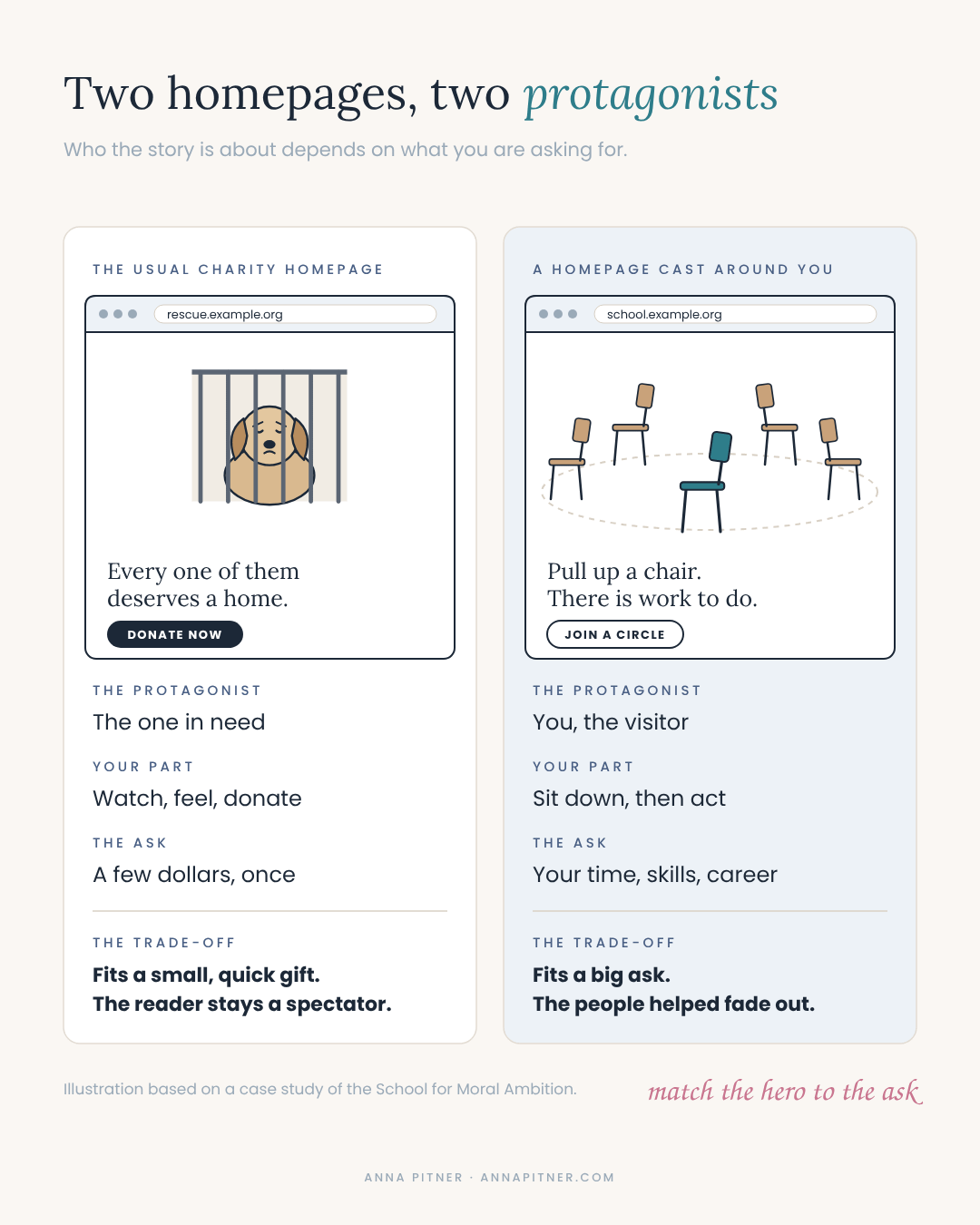
Picture a charity’s website. What do you see first? Almost always, someone it helps. A hungry child. A dog behind bars. The person in need is the protagonist. You are the audience, and your part ends at the donate button.
Now picture a nonprofit that built its brand around a chair.
The School for Moral Ambition did exactly that. Its icon is the Result chair that stood in every Dutch classroom in the 1960s and 70s, arranged in a circle with a seat for you. The first time I saw it, my honest reaction was: what? A chair? Then it clicked.
I came to SMA from effective altruism, so many of its ideas sounded familiar. What surprised me was how far a new organization got with them. It seemed to reach totally new people, and with much less pushback than EA tends to get. That’s an impression I can’t measure, but it’s why I wanted to look closely at how SMA tells its story.
I think the chair follows from the size of the ask. The face of someone in need is built for a small, one-time gift. SMA asks for something much larger: your career. And for an ambitious audience, the research leans the other way. A US business school once turned its annual alumni appeal into an experiment. The version framed around one person coming forward to take action raised 82% more per recipient than the version framed around a shared goal.
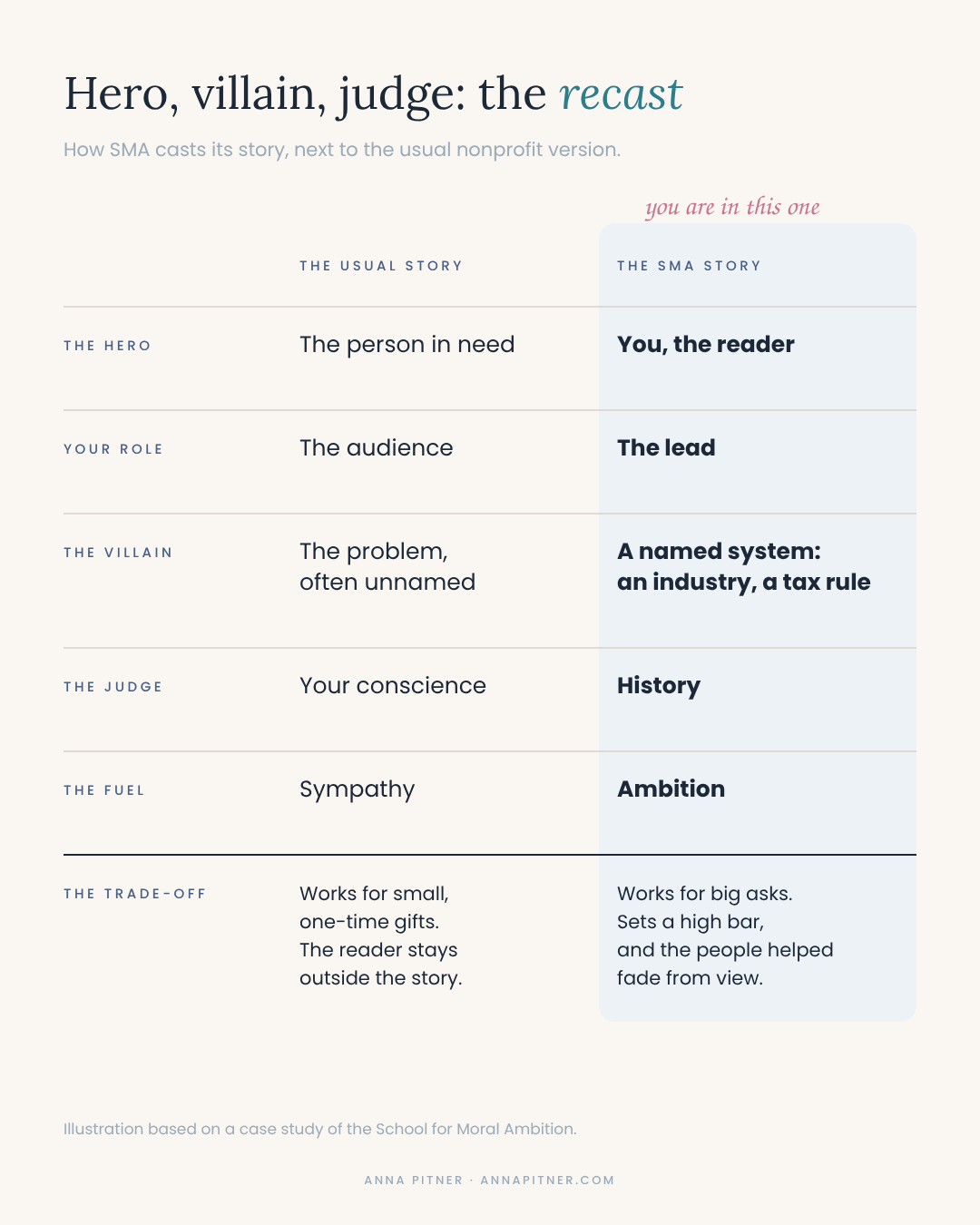
So SMA rewrites the cast. The reader gets the lead role, a system gets the villain’s part, and history plays the judge.
The hero: the reader
SMA says it plainly in its 2025 impact report: the first bottleneck it exists to fix is prestige. Doing good should become prestigious enough to attract the world’s most ambitious people. The brand is where you can see that goal at work.
One of the five co-founders, Harald Dunnink, is a designer whose agency worked for Nike and Red Bull. He describes his job as making doing good look as good as possible. It shows. Most nonprofit websites look much the same, and so do the stories they tell. When I first came across SMA, the brand felt like nothing else in the sector. It had energy. It made me want to get up and do something. It also looked finished from day one, which is unusual for a young movement.
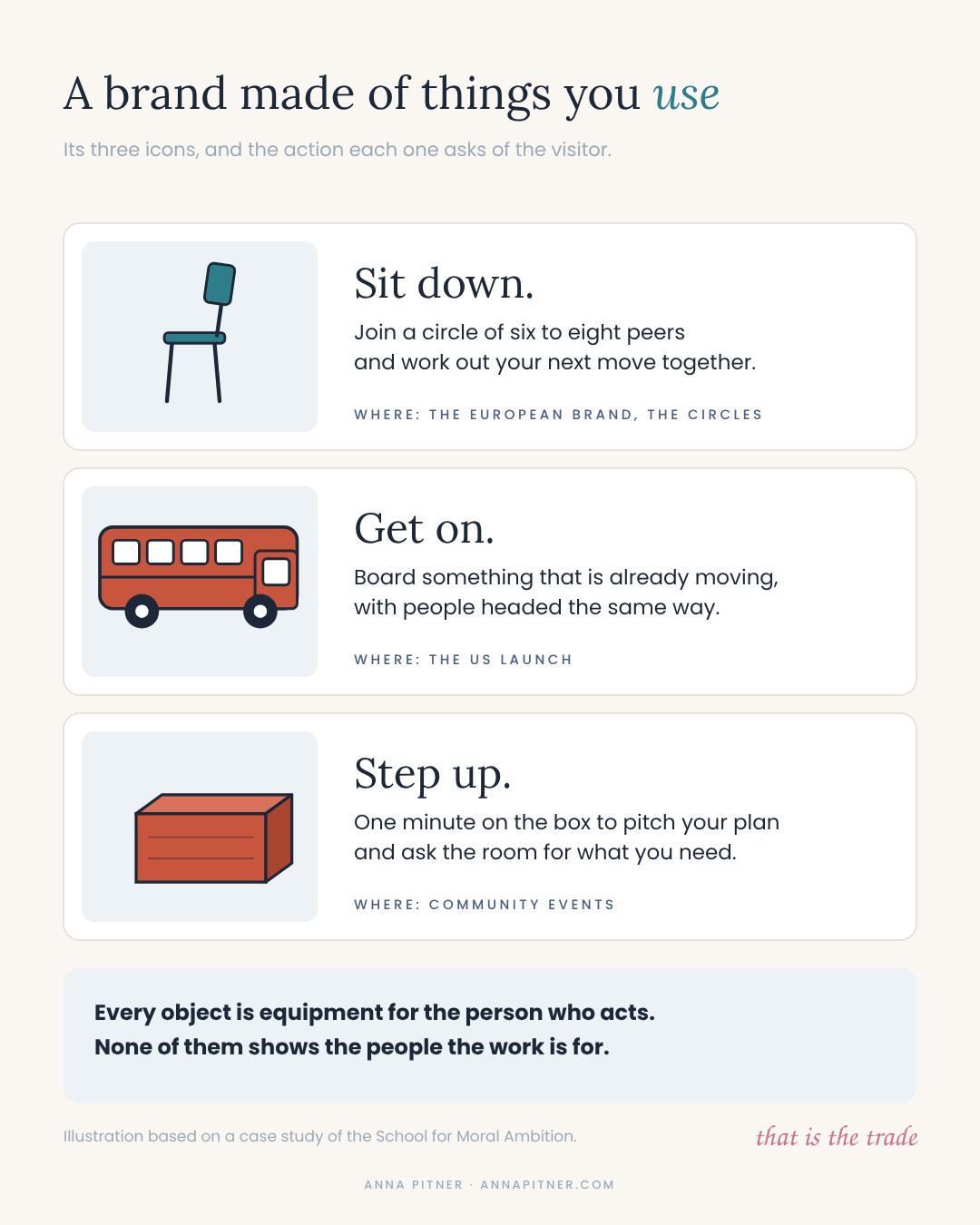
Look at what the brand is built from. The chair in Europe. A red school bus in the US. A red soapbox at community events, where members get one minute to pitch their plan. None of these objects shows anyone in need. Each one is something you use: you sit down, you get on, you step up and speak. Even the words are about becoming someone. You enroll in a School. You are selected for a Fellowship. The first words on the homepage are an instruction to the visitor: start solving the world’s biggest problems.
Fundraisers have heard part of this before. StoryBrand, a messaging framework popular with nonprofits, tells them that the donor is the hero and the organization is the guide. In that version the donor still saves someone, and that person is what’s at stake. SMA removes that person. In its stories, the thing in danger is your own talent, wasted in the wrong job; its rallying line is “stop the waste of talent.” You play the hero and the one who needs rescuing at the same time.
The stories follow the same casting. Profiles on the School’s site share a template: a person who was one thing, until they became another. The protagonist starts where the reader is, often inside the enemy camp. One headline introduces its subject as “the lung doctor who smoked.”
Another follows Joachim Verheyen. He had a comfortable corporate job in Antwerp and a climate-activist life he never mentioned to his colleagues. Two months after quitting to join SMA’s tobacco fellowship, he was testifying in Moldova’s parliament. Asked about it, he skipped the usual language of sacrifice: “maybe it’s my ego talking, but to me it’s also just pretty cool.” A charity appeal would edit that line out. SMA published it, in keeping with a founding principle that names enthusiasm as the fuel and rules out guilt by name.
A hero with no guilt raises an awkward question, though. If the reader is not to blame, who is?
The villain: a system
SMA’s answer is an industry or a system, and it keeps the reader off the list of suspects. Every cause it takes on comes with a named opponent. Tobacco is, in the School’s words, “an industry that earns more than Google, Meta, and Apple combined.” One of its explainers is titled simply “Abolish the Tobacco Industry.” On tax, a video explains why billionaires pay less tax than you. In each case the blame lands outside the room.
Inside the stories, the same move turns a culprit into a hostage. Wanda de Kanter, the lung doctor who smoked, treated her habit as her own responsibility, and her patients blamed themselves when they got lung cancer at forty. “These people were made sick,” she says now. The self-blame story has authors. Oxford researcher Benjamin Franta calls it a “blame the consumer” strategy, and he compares BP’s push to popularize the personal carbon footprint to the tobacco industry’s playbook.
With the villain outside the room, the reader can face it head on. When Joachim walked into the Moldovan hearing, eight or nine people from the tobacco side were already seated in a line across the room. In his first week of training, a group of lung doctors had handed the fellows a bingo card of the arguments the industry uses against regulation. As the hearing went on, he ticked off the boxes.
Food is the hardest test, because no cause has argued longer about personal behavior. For years, animal advocates have argued about whether asking people to go vegan helps or backfires. SMA’s food explainer goes after intensive animal agriculture and the policies that hold it in place; veganism doesn’t come up. Its fellows build coalitions in Brussels for a more diverse mix of proteins. One of them, Katrien Martens, went plant-based as a teenager and describes what she left behind: “It doesn’t feel right being a finger-pointing moralist and blaming people around you.”
A villain explains why the fight matters. The harder question is why anyone would sign up for a fight that may outlast them.
The judge: history
Most social proof points sideways: look how many people like you already do this. SMA points forward. Its principles place members in a line that runs through the abolitionists and the suffragettes, and ask them to be good ancestors.
The same page tells a story that would sink most recruitment pitches. Of the 68 women who met at Seneca Falls in 1848 for the first women’s rights convention, only one lived to see women win the vote. In SMA’s telling, that is the point. A career spent on a problem this size needs a judge who will still be watching after you have gone, and history is the only one available.
History also keeps the hero modest. Moldova’s tobacco reforms passed after Joachim’s testimony. Looking back, he does not claim the win: “I hope I played a small part in that success.”
In most nonprofit stories, the future appears as a beneficiary. Here it is also the jury.
What doesn’t transfer
Not all of this is easy to copy. SMA started with a famous historian and a well-known design agency on board from day one, since the agency’s founder is also an SMA co-founder. Most organizations have neither, so it’s hard to know how much of SMA’s success comes from the story and how much from that head start.
The message might also go too far. Many people heard “quit your job and change the world,” and many of them didn’t want to quit. SMA admitted this and rebuilt its program around smaller steps.
The biggest trade-off is simplicity. SMA offers a “normie friendly” version of EA’s ideas. That draws less pushback, but it also leaves out important-yet-neglected ideas. Is that a fair price for reaching people EA never reached? Good question.
Choose your cast
Every story your organization tells has a cast, whether you chose it or not. Most nonprofits inherit theirs: someone in need at the center, the reader in the audience. SMA chose its cast on purpose, and chose it for the size of what it was asking. Before your next campaign, look at your homepage and ask who it is about. If the answer is never the person you hope will join, you have found your first edit.
The face of someone in need still works when you ask for a few dollars. When you ask for a career, SMA bets on a different face: yours.
Hi, I’m Anna. I spent eight years (and over 200 clients) getting really good at one thing: making people take action. Marketing always struck me as a serious force for good that mostly gets pointed at trivial things, so now it is one thing: the same skill set, aimed where I think it counts most. I help small EA and social impact teams go from “we need to grow” to a way of growing that is built, tested, and handed over.
If this piece raised a question about your own program, two ways to take it further:
Book a call if you want to think through what would transfer to your organization.
The Growth Map your next 90 days, planned in one week. For small teams that need to grow, have a dozen ways they could, and nobody whose whole job is picking the right one.
And if you want the next case study when it is out, subscribe here.
Thank you for noticing all the details, Anna! It took the whole team, fellows included, to tell the stories with that much enthusiasm.
We had a head start, true. But choosing your cast costs nothing, so any nonprofit can do it.
The AI writing smell is strong and makes this a bit tough to read, but I love the ideas behind it that you're bringing to light!